Keep the SaaS console
Non-engineers need a multi-product control plane, or you already standardized on a hosted observability suite.
Self-hosted admin
Most teams rent an ops console to watch jobs they already run. NexusAdmin is that dashboard as source, on Docker, next to the rest of your stack.
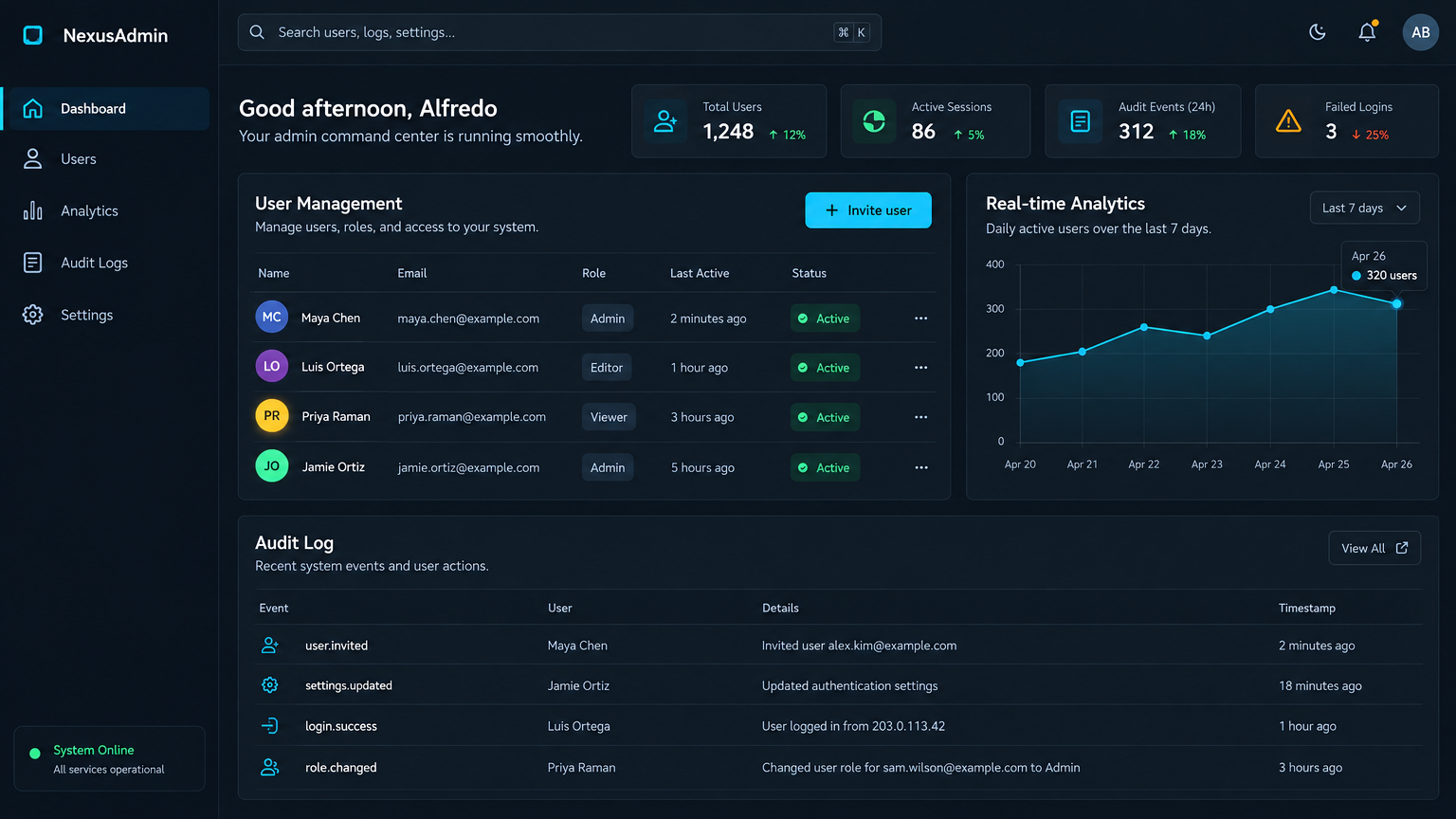
A scheduler without a screen is a crontab. A pipeline without a screen is a log file. NexusAdmin is the dashboard that sits beside NexusPipeline so you can see jobs, history, and health without opening another SaaS tab.
01
Jobs, runs, and health on the same host as the engine. No extra tenant.
02
Create, retry, and inspect work without SSH and without a vendor UI.
03
Operator views stay on disk you control. Nothing is billed per seat.
Non-engineers need a multi-product control plane, or you already standardized on a hosted observability suite.
The stack is already self-hosted. You want the screen on the same box, not another login and another invoice.
It sits next to NexusPipeline. Cron and webhook setup live in their own guides. The NexusAdmin product page has the license.
Pay once on Whop, download the source, clone it onto the machine that already runs your stack. Compose up. The dashboard is local. There is no account to create.
git clone <your NexusAdmin source>
docker compose up -d
Open the dashboard on the host port in the compose file.
Point it at the NexusPipeline instance on the same network.
Confirm jobs and run history show up without a vendor login.
NexusAdmin
$94.99one-time, lifetime license
Checkout stays on Whop. You get the source after payment.
It is the ops dashboard for your NexusCore stack, not a generic metrics product. If you need org-wide observability across twenty services, keep Grafana. NexusAdmin is for the jobs, pipelines, and webhooks you just self-hosted.
It is built to sit next to NexusPipeline. You can run it on its own, but the point is one dashboard on the same machines as the rest of the stack.
On the host you deploy. There is no vendor tenant holding operator views or job history.
Only if you want the dashboard. Webhook Router, NexusCron, and NexusPipeline each have their own license. The Full Platform Bundle is all four together.
Guide
Stop paying a monthly bill to fire HTTP on a timer. NexusCron is a self-hosted cron alternative you deploy with Docker on machines you already own.
Guide
Compare EasyCron, cron-job.org, and other hosted cron products with NexusCron. Same job, no subscription, logs and secrets stay on your disk.
Guide
Step-by-step migration from EasyCron to a self-hosted cron runner. Export jobs, map cron expressions, Docker Compose, HTTP pings, and cutover without downtime.
Guide
Technical guide for migrating cron jobs off cloud providers to self-hosted NexusCron. Architecture, Docker Compose, job mapping, and cutover without missed pings.
Guide
Architecture, Docker Compose, production env vars, and cutover for replacing hosted cron with NexusCron on a VPS you already run. One lifetime payment.
Guide
Architecture, Docker Compose, and cost math for replacing $20–$50/month hosted cron with NexusCron on a VPS you already run. One lifetime payment.
Guide
A self-hosted webhook router that receives, transforms, and forwards events on your infrastructure. One payment. No Zapier tax for simple routing.
Guide
Architecture, Docker Compose, and config mapping to replace Hookdeck, Svix, Zapier, and Make with NexusCore Webhook Router on your VPS. One lifetime payment.
Guide
Technical architecture for replacing cloud webhook queues with local SQLite routing. Production Docker Compose, under 50MB RAM, WAL mode, retries, and dead-letter replay.
Guide
NexusPipeline is a FastAPI Docker execution engine. Clone it, compose up, and keep job state on disk you control. One payment. No worker SaaS.
Guide
LogStream is a single-binary Node.js collector. HTTP and UDP ingest, SQLite, live dashboard, webhook alerts. One payment. No observability SaaS.
Guide
EnvSync Agent syncs .env values across VPS hosts, laptops, and microservices. Encrypted key-value store. One payment. No secrets tenant.
Guide
API Proxy Service sits between your code and upstream APIs. Retries, rate limits, fallbacks, circuit breakers. One payment. No gateway SaaS.